
 Muni's Play
Source: https://www.frontiersin.org/journals/human-neuroscience/articles/10.3389/fnhum.2012.00296/full
Biased Self-Processing: A Contemporary Model for Suffering
Suffering arises from a “reified” self-schema that systematically distorts reality.
The Core Mechanism: Affect-Biased Attention
The paper defines the “distorted or biased sense of self” through the lens of how we process emotional stimuli:
-
Valence Distinctions: Unlike the mindfulness goal of impartiality and equipoise, a biased mind treats positive or negative stimuli differently than neutral material.
-
Attentional Capture: Resources are captured by “biased” representations of the world, often rooted in real or imagined stimuli from the past or future rather than the momentary experience.
| Term | Mechanism | Consequence |
|---|---|---|
| Facilitated Engagement (Hypervigilance) | Enhanced monitoring and orienting toward self-relevant or threatening stimuli. | Resources captured before full subjective awareness; artificially increased threat perception. |
| Avoidance | Reduction of elaborative or evaluative processing; deflation of threat value. | Automatic or strategic emotion regulation that prevents phenomenal clarity. |
| Disengagement Delays (“Mental Stickiness”) | Inability to withdraw or inhibit selection; resources stay dedicated to an object of engagement. | Inability to “let go” and re-orient; prevents capture of pertinent environmental information. |
Systems of Self in the S-ART Framework
| Self Type | Definition (Functional Aspect) | Core Processes |
|---|---|---|
| Enactive Experiential Self (EES) | Non-conscious sensory-affective-motor processing. The “physical self” or “proto-self” representing embodied enaction. | Sensorimotor coupling, Exteroception (5 senses), Proprioception, Kinesthesia, Interoception (visceral feedback), and repeated associative conditioning. |
| Experiential Phenomenological Self (EPS) | Agentic “self-as-subject.” The “minimal self” or “knower” acting as awareness in the present moment without reflection. | First person perspective (FPP), meta-awareness, top-down attentional control, vigilant monitoring, response readiness, and present-centered sensory-perceptual awareness. |
| Narrative Self (NS) | Evaluative “self-as-object.” Reflecting the autobiographical narrative reconstructed from the past or projected into the future. | Self-reflection, episodic memory formation, affective appraisal, self-identification, mental proliferation (rumination), and evaluative mentation. |
Correspondence with the 5 Koshas (NOT from the paper!)
The Koshas describe a progression from the densest physical layer to the subtlest state of bliss.
| S-ART System | Corresponding Kosha | Functional Overlap |
|---|---|---|
| Enactive Experiential Self (EES) | Annamaya & Pranamaya | Both describe the non-conscious “physical self” (Annamaya) and the “energy/vital self” (Pranamaya). They focus on interoceptive, kinesthetic, and sensorimotor coupling. |
| Narrative Self (NS) | Manomaya | This is the “mental sheath” composed of thoughts, emotions, and the “Me-self.” It is the layer of mental proliferation and autobiographical story-telling. |
| Experiential Phenomenological Self (EPS) | Vijnanamaya | This is the “wisdom/intellect sheath.” It represents the “knower” or agentic subject that possesses meta-awareness and top-down control over the lower layers. |
| Self-Transcendence (Goal of S-ART) | Anandamaya | The “bliss sheath.” In S-ART, this is the state where the reified self is deconstructed, leading to a “positive relationship between self and other” and a loss of separate identity. |
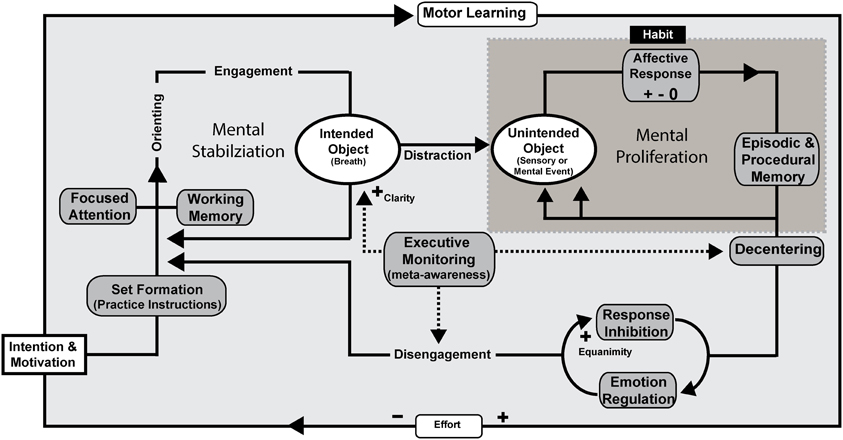
Focused Attention (FA): Stabilizing the Mind
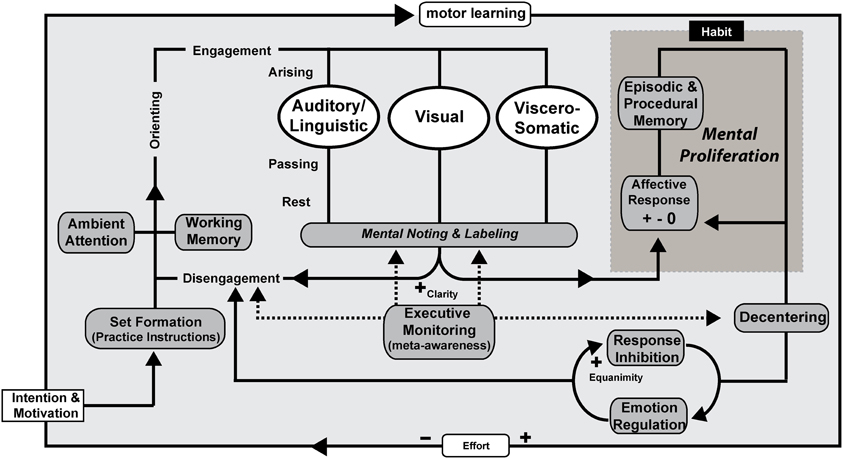
Open Monitoring (OM): Receptive Practice
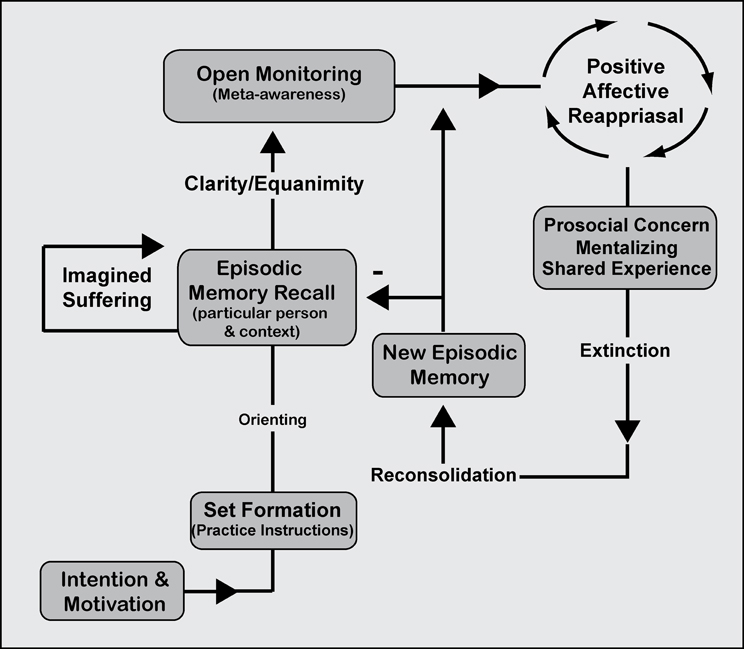
Ethical Enhancement (EE): Breaking the Barriers
Summary of the 3 Meditative Processes
| Practice Type | Core Goal | Primary Attentional Focus | Key Mechanisms / Tools |
|---|---|---|---|
| Focused Attention (FA) | Mental Stabilization | Concentrative: Sustained attention on a single mental or sensory object (e.g., breath). | Executive Set, Working Memory, Orienting, and Engagement. |
| Open Monitoring (OM) | Receptive Awareness | Ambient/Diffuse: Monitoring all modalities of experience without a focal point. | Mental Noting & Labeling (Arising, Passing, Absent), Decentering, and Ambient Attentional Networks. |
| Ethical Enhancement (EE) | Prosociality & Compassion | Relational: Sustained episodic memory recall involving shared experience and mentalizing. | Positive Reappraisal, Mentalizing, and Prosocial/Empathic Concern. |
| Practice Type | Cognitive Shift | Behavioral/Emotional Result | Impact on the “Self” |
|---|---|---|---|
| Focused Attention (FA) | Automatization: Transition from effortful to effortless control via motor learning. | Equanimity & Clarity: Reduced sympathetic arousal and cognitive elaboration. | Meta-awareness: Awareness itself becomes the object of attention. |
| Open Monitoring (OM) | Neutralization: Extinction and reconsolidation of maladaptive scripts/schemas. | Non-reactivity: Decreased allotment of resources toward any particular feeling or thought. | De-fusing: Thoughts are no longer fused with reality; move toward Non-dual Awareness. |
| Ethical Enhancement (EE) | Memory Reconsolidation: Replacing negative associations with adaptive/positive episodic memories. | Impartiality: Breaking down barriers between self, friends, and difficult persons. | Self-Transcendence: Shifting from self-focused needs to a boundless heart for all beings. |
The Six Neurocognitive Mechanisms of S-ART
| Mechanism | Functional Goal | Key Processes & Neurobiology |
|---|---|---|
| 1. Intention & Motivation | Drives goal-directed behavior and acts as a feedback system for self-schema maintenance. | Motivation shifts from external (reward-based) to internally driven (equanimity-focused). Key regions: DLPFC (sustained motivation in working memory), Anterior PFC, and the Ventral Striatum/nAcc (dopamine/reward). |
| 2. Attention Regulation | Provides volitional control over shifting and managing conscious awareness. | Components include alerting, orienting, engaging, sustaining, monitoring, disengaging, and re-engaging. Advanced practice yields effortless control and reduced resource allocation (e.g., smaller attentional blink). |
| 3. Emotion Regulation | Enables the shifting of focus to modulate emotional activity and viscerosomatic responses. | Uses automatic (homeostatic/non-conscious) and controlled (antecedent or response-focused) strategies. Features the “Raincoat effect” (protection) and “Towel effect” (recovery). Key regions: OFC, VLPFC, and Insula. |
| 4. Extinction & Reconsolidation | Transforms the reified Narrative Self (NS) into more adaptive trajectories. | Extinction involves novel learning to weaken old associations; Reconsolidation creates new, adaptive memory traces. Key regions: Hippocampus, Amygdala, and VMPFC (extinction recall). |
| 5. Prosociality | Improves social cognition, empathy, and shared experience. | Cultivates interdependence and self-transcendence, dissolving distinctions between self and other. Key regions: TPJ (agency/ownership), pSTS (social perception), and AIC (empathy mapping). |
| 6. Non-attachment & De-centering | Facilitates the realization of “no-self” and the impermanence of all objects. | Decentering provides a “space between perception and response”. Non-attachment is a “release from mental fixations” (grasping and aversion). Key regions: DMPFC, dACC, and PIC. |
| Pillar | Definition & Core Focus | Functional Goal | Supporting Mechanisms |
|---|---|---|---|
| Self-Awareness | Development of meta-awareness of the self. | To become aware of the conditions that cause or remove distortions and biases in internal/external experience. | Intention, Motivation, and Attention Regulation. |
| Self-Regulation | The ability to effectively manage or alter one’s responses and impulses. | To reduce habitual reactivity, “mental stickiness,” and facilitate a rapid return to physiological/emotional baseline. | Emotion Regulation, Extinction, and Reconsolidation. |
| Self-Transcendence | Development of a positive relationship between self and other that transcends self-focused needs. | To increase prosocial characteristics and dissolve the rigid, “reified” boundaries of the Narrative Self. | Prosociality, Non-attachment, and De-centering. |
Correspondence Between S-ART and Sadhana Chatushtaya
| Sadhana Chatushtaya Element | S-ART Functional Mechanism | Neurocognitive / Behavioral Alignment |
|---|---|---|
| 1. Viveka (Discrimination) | Meta-awareness & Decentering | The ability to distinguish between the “knower” (EPS) and the “known” (thoughts/objects). Viveka is the root of Meta-awareness, allowing one to “see and know” mental patterns. |
| 2. Vairagya (Dispassion/Detachment) | Non-attachment & Equanimity | Defined as a “release from mental fixations” (grasping and aversion). It manifests as Equanimity, which reduces the “stickiness” of affective responses. |
| 3. Shat-Sampat (Six Virtues) | Attention & Emotion Regulation | The “six virtues” (e.g., Shama - mind control, Dama - sense control) map to Attention Regulation and Emotion Regulation. These develop the “supervisory gateway” (FPCN) to manage reactivity. |
| 4. Mumukshutva (Longing for Liberation) | Intention & Motivation | The “purposive plan of action” and internal drive that initiates the practice. In S-ART, Intention provides the initial steps for extinguishing maladaptive habits. |
Link to Dahl et al.
| ART Pillar | Meditation Family (Dahl et al.) | Key Practices | Targeted Self-System |
|---|---|---|---|
| Self-Awareness | Attentional | Focused Attention, Breath Counting, Shamatha. | EPS (Experiential Phenomenological Self). |
| Self-Regulation | Constructive | Loving-kindness, Values Contemplation, Compassion. | EES (Experiential Enactive Self). |
| Self-Transcendence | Deconstructive | Vipassana, Self-inquiry, Nondual Insight (Mahamudra/Zen). | NS (Narrative Self). |